Built in Japan for bank and central bank sandboxes
Making regulated digital money spendable.
The merchant acceptance layer for national stablecoins and bank-issued digital money. Identity verified before any value moves.
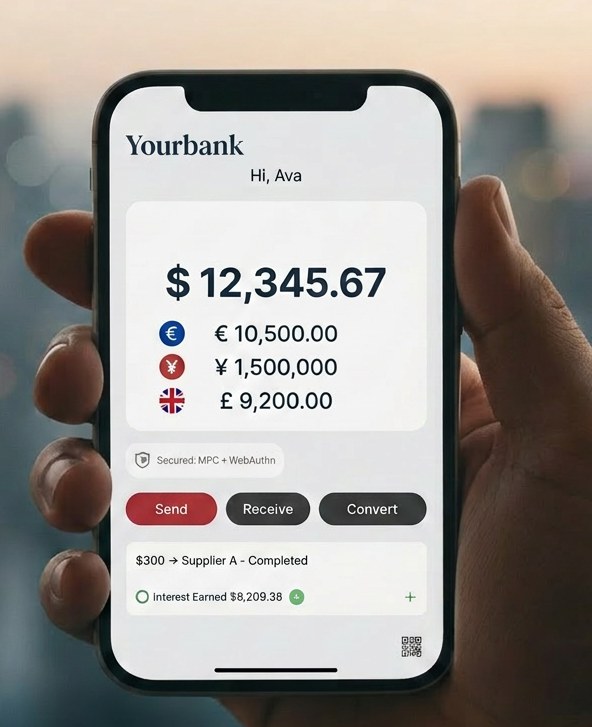
The merchant acceptance layer for national stablecoins and bank-issued digital money. Identity verified before any value moves.
A digital currency pilot is judged on one thing: real transactions at real merchants. BitVoy supplies the acceptance side, the checkout, the merchants, and the audit evidence a supervisor wants to see.

Your stablecoin or digital currency becomes spendable at real stores within the pilot. Every payment produces a supervisory record: verified identity, authorized intent, execution, settlement.
Your institution owns the customer experience and the relationship. BitVoy provides the acceptance technology underneath, and your compliance policy is enforced at the payment layer.
Visitors and overseas customers pay at local merchants, settling into locally regulated money through your institution. New inbound volume, fully supervised.
A sandbox has twelve months to prove that a digital currency can be issued, circulated and redeemed safely. Issuance is the part that gets done. Acceptance is the part that decides whether the currency is used, and it is where three of the five usual evaluation criteria are decided.
Every payment through the layer produces one record with four fields. It is created by the payment flow itself, not reconstructed from chain data afterwards.
Most digital-asset payment systems move funds first and reconcile later. BitVoy inverts that. Every payment begins as a signed intent, identity is verified before value moves, and settlement produces a record a supervisor can read.
The merchant issues a payment intent: exact amount, currency and destination.
Eligibility checks run before anything moves, not after settlement.
The customer signs that specific intent with a passkey. One biometric tap.
BitVoy submits the payment on the customer's behalf. No gas fees, no wallet set-up.
Finality confirms funds to the merchant, with an auditable record tied to the approved intent.
Recorded on a live merchant integration in Japan. From cart to confirmed payment in one short clip. The customer pays in a regulated yen stablecoin, settlement is confirmed, and the paid order is created automatically.
Regulated stablecoins in dollars and yen are live at checkout today. National and bank-issued currencies plug into the same flow as they launch, without re-integration.
A single biometric authentication completes the payment. No private keys for users to lose, nothing to phish.
Signing keys are split three ways with two-of-three signing. No complete private key exists anywhere in the system.
Funds move directly from customer to merchant on the issuer's chain. They never pass through BitVoy.
Engineered under Japan's Payment Services Act and built to map onto any jurisdiction's framework. Compliance is enforced at the intent layer, before settlement.
BitVoy is developed by Bay Bridge Inc., Tokyo. The architecture was designed by Keiichi Noda, senior researcher in blockchain security at the Keio Research Institute, and its core is covered by patent filings at the Japan Patent Office. We are engaged with stablecoin initiatives connected to the BIS and have presented our architecture directly to Japan's FSA.

Founder and Chief Executive

Co-founder and Chief Business Officer

Chief Technology Officer

Chief Financial Officer

Developer
A first briefing takes thirty minutes: technical integration, the supervisory record, and what it takes to put your first merchants live.